Ice does not change who is at fault in Alberta. The province’s fault rules for vehicle damage claims say fault is decided without looking at the weather or visibility, so if you slide into the car ahead of you, you are normally 100% at fault, even at low speed. Your own insurer handles the claim for your vehicle.
That surprises a lot of drivers in Sherwood Park every November, when the first freeze turns Baseline Road, Wye Road and Highway 16 into skating rinks. Here is how fault works on ice, who pays for the repair and what to do in the first hour after a winter fender bender.
We read these rules in the Government of Alberta’s Direct Compensation for Property Damage Regulation (Alberta Regulation 132/2021) in November 2026. This is general information, not legal advice. Your insurer makes the call on your claim, so confirm the details with them.
Does bad weather change who is at fault in Alberta?
No. When two vehicles collide in Alberta, insurers set each driver’s share of fault for vehicle damage using a set of fault determination rules written into provincial regulation. Section 2 of that regulation says fault must be decided without reference to the circumstances in which the accident occurs, including weather conditions, visibility or the actions of pedestrians.
In plain words, “the road was a sheet of ice” is not a reason an insurer can use to lower your share. The rules look at what each vehicle was doing: following another car, turning, backing up, parked, or going through a stop sign.
There are two main exceptions. If a crash does not fit any of the situations in the regulation, or there is not enough information to apply them, fault is decided under the ordinary rules of law instead. The same can happen when a driver is charged with certain offences after the crash, such as impaired driving or speeding by 31 km/h or more over the limit, and the rules would otherwise put some of the fault on the other driver.
Who is at fault in common winter crashes?
These are common crashes once the snow starts, and what the regulation says about each one:
- You slide into the back of another car in the same lane. You are normally 100% at fault, whether the car ahead was stopped or moving forward. This is the most common winter crash and the one that catches people off guard.
- You slide into a parked car. The moving driver is 100% at fault. The one exception is a car parked illegally outside an urban area, where the parked driver can be found at fault instead.
- You are backing out of a driveway or parking stall and slide into someone. The driver backing up is 100% at fault.
- You slide through a stop sign and hit a car. The driver who does not obey the sign is 100% at fault. If both drivers miss their stop signs, each is 50% at fault.
- A chain reaction in one lane. Each contact between two vehicles is judged on its own, and the driver at the back of the chain is usually the one found 100% at fault.
- A pile-up across lanes. When vehicles travelling in the same direction in side by side lanes crash one after another, each driver is 50% at fault for each contact.
- You slide off the road into a ditch, curb, pole or snowbank on your own. There is no other driver to share fault with, so the rules for splitting fault between drivers do not come into it. Damage to your vehicle is a claim on the collision coverage of your own policy, if you carry it.
Who pays to fix your car after a winter crash?
Since January 1, 2022, Alberta has used a system called Direct Compensation for Property Damage. Under it, you claim the damage to your own vehicle through your own insurer, to the extent you were not at fault, as long as the crash happened in Alberta and the other vehicle is insured by a company licensed in Alberta (or one that has agreed to follow Alberta’s rules).
If you were partly at fault, the system covers the share you were not at fault for. The rest of the damage falls under the collision coverage on your own policy, if you have it. How your deductible applies depends on your policy and your share of fault, so ask your insurer to explain it before the repair starts.
What should you do right after a winter fender bender?
- Get safe first. Turn on your hazard lights. If anyone is hurt, call 911. On an icy road, stand well back from traffic, since the next car may slide too. If the vehicles can be moved and it is safe, move them off the road.
- Take photos before anything moves. Get every vehicle, the damage, the licence plates, any traffic signs and where each car ended up. The weather will not decide fault, but where the cars were and what each driver was doing will.
- Swap information. Names, phone numbers, driver’s licences, plate numbers, insurance companies and policy numbers. Get names and numbers from any witnesses.
- Do not argue about fault at the scene. Your insurer applies the rules. A friendly “sorry about that” or a heated debate on the shoulder will not change the outcome and can muddy the record.
- Report the crash if you need to. You must report a collision to police in Alberta if anyone is hurt or the combined damage meets the provincial reporting threshold. In Sherwood Park and the rest of Strathcona County, collisions go to the Strathcona County RCMP at 911 Bison Way. Some single vehicle crashes, like sliding off the road or hitting a post, can be reported online through the Government of Alberta’s Report My Collision portal. Our guide to collision reporting in Sherwood Park and Edmonton has the hours, the threshold and what to bring.
- Call your insurer. Report the crash as soon as you can, even if the damage looks small.
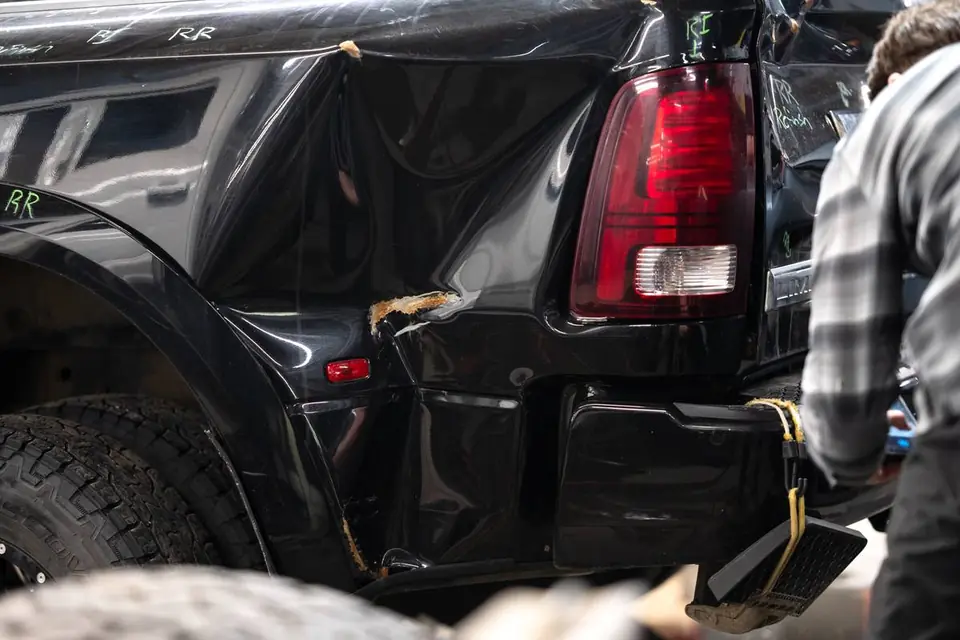
- Get the damage checked properly. Cold plastic is brittle, so a bumper cover that looks scuffed can hide cracked brackets, mounts or energy absorbers behind it. A free written estimate shows what is really there before you decide anything.
Can you choose your own shop after a winter crash?
Yes. In Alberta you choose where your vehicle is repaired, even when your insurer suggests a shop from its own list.
Where can you get winter collision damage checked in Sherwood Park?
Fix Auto Sherwood North, the local shop we recommend, handles collision repair, bumper repair, frame straightening and paint matching in house, and bills Alberta insurers directly. The shop is at Unit 100, 167 Provincial Ave, Sherwood Park, AB T8H 0M3, just north of Millennium Place off Highway 16, serving drivers across Strathcona County. Book a free written estimate online or call (780) 416-3158, Monday to Friday, 8 AM to 5 PM.
Common questions
Who is at fault if I slide on ice and rear-end someone in Alberta?
Usually you are. Under Alberta’s fault rules, when one vehicle hits the back of another in the same lane, the driver at the back is 100% at fault, whether the car ahead was stopped or moving forward. Ice, snow and poor visibility do not lower your share.
Do road conditions count when Alberta insurers decide fault?
No. Alberta’s Direct Compensation for Property Damage Regulation says fault must be decided without reference to the circumstances of the crash, including weather conditions and visibility. Insurers look at what each driver was doing, such as following, turning, backing up or going through a stop sign.
If another driver slid into me, which insurer do I call?
Your own. Since January 1, 2022, Alberta drivers claim damage to their own vehicle through their own insurer under Direct Compensation for Property Damage, to the extent they were not at fault, when the crash happens in Alberta and the other vehicle is insured by a company licensed in Alberta (or one that has agreed to follow Alberta’s rules). You do not need to chase the other driver’s insurance company for your repair.
Do I have to report a minor winter fender bender in Sherwood Park?
You must report it to police if anyone is hurt or the combined damage meets Alberta’s reporting threshold. In Sherwood Park and the rest of Strathcona County, that means the Strathcona County RCMP at 911 Bison Way. Some single vehicle slides can be reported online through the Government of Alberta’s Report My Collision portal.
The bottom line
On Alberta ice, fault follows what each car was doing, not how slippery the road was. Leave extra room this winter, and if you do slide into someone, stay safe, take photos, report it if the rules require it, call your own insurer and get a written estimate before small damage turns into a bigger problem.